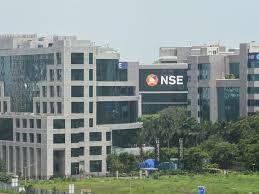
In February 2026, the National Stock Exchange issued a circular revising the Investor Protection Fund Trust (IPFT) contribution framework, with the changes coming into effect from March 1, 2026.
The decision came after the exchange determined that the IPFT corpus had reached sufficient levels, allowing it to recalibrate how contributions linked to trading activity are collected.
While the change may appear technical at first glance, it highlights an important aspect of exchange economics. Adjustments to transaction-related charges — even when they involve investor protection mechanisms — can influence the overall fee structure associated with trading activity on the exchange.
For NSE, which derives a significant portion of its income from transaction-based revenue streams, even small changes to fee frameworks can have meaningful implications.
🏛️ Company Overview
- Founded: 1992
- Headquarters: Mumbai, Maharashtra
- Business Model: India’s leading multi-asset class exchange with dominant market share across equity cash, equity derivatives, currency derivatives and listing services.
- Scale & Ecosystem: World’s largest derivatives exchange (by contracts)
- 3rd largest equity exchange globally (by number of trades)
- 2,720+ listed companies
- 24+ crore investor accounts
- A fully integrated market infrastructure ecosystem spanning trading, clearing, settlement, indices, technology and data services.
NSE is widely regarded as the backbone of India’s capital markets with deep network effects, best-in-class infrastructure and consistent profitability across cycles.
📈 NSE IPO: A Decade-Long Journey Toward Listing
2016 – NSE files its Draft Red Herring Prospectus (DRHP), targeting an IPO of over ₹10,000 crore
2018–2019 – IPO put on hold following the emergence of co-location and governance concerns
2021 – SEBI imposes penalties; leadership restructuring undertaken, IPO plans shelved
2022–2023 – NSE settles regulatory cases, pays fines, and undertakes comprehensive governance clean-up
2024 – NSE reapplies for listing and seeks SEBI’s No-Objection Certificate (NOC)
January 2026 – SEBI Gives NOC To NSE IPO After 10-Year Wait..
📊Financial Snapshot (Consolidated, ₹ in crores)
9MFY26 vs 9MFY25

⚙️Operational & Strategic Highlights
- Revenue from operations declined 13% YoY to ₹11,634 Cr, primarily due to lower transaction charges (₹8,968 Cr vs ₹10,684 Cr, ↓16%) and a sharp fall in clearing & settlement income (₹172 Cr vs ₹266 Cr, ↓35%).
- “Others” segment increased to ₹474.75 Cr (↑13% YoY), supported by data feed services, investments, and index-related income streams.
- Operating EBITDA declined 24% YoY to ₹7,465 Cr, as total expenditure rose 18% YoY, driven by higher technology expenses (↑34%) and elevated regulatory settlement costs.
- Non-operating income rose to ₹1,720 Cr (↑22% YoY), supported by higher treasury income, which helped cushion the drop in core operating revenue.
- A large SEBI settlement provision of ₹1,307.41 Cr was recognized for Colocation and Dark Fibre matters, representing a major non-recurring cost during the period.
- NSDL stake sale generated a pre-tax gain of ₹1,200.94 Cr, boosting reported profitability despite operational softness.
- Divestment of non-core businesses improved strategic focus, with the TalentSprint sale delivering ₹113.99 Cr net gain and the KRA business transferred to CAMS.
- A one-time ₹126.44 Cr provision was recorded following reassessment of employee benefits under the new Labour Codes.
🏆 Market Leadership Remains Unchallenged
Despite earnings pressure, NSE’s competitive position remains exceptionally strong:
- ~93% market share in the cash market
- Nearly 100% share in equity futures
- 73% share in equity options
- Full dominance in currency derivatives
These metrics reaffirm NSE’s status as one of the world’s largest multi-asset exchanges and highlight the depth of its trading ecosystem. Q3FY26_Earnings_Presentation_NS…
The exchange also continues to play a central role in capital formation, facilitating large-scale equity and debt fundraising while expanding investor participation across India
💹Valuation Snapshot And Peer Comparison

NSE trades at lower valuations than BSE despite far superior market share, scale, and liquidity dominance
📜 February 2026 Circular: Transaction Charges & IPFT Contribution Revision
The Investor Protection Fund Trust (IPFT) is a fund maintained by stock exchanges to compensate investors in case a broker defaults or fails to meet settlement obligations. The fund is built through small contributions collected on every trade executed on the exchange.
Before the February 2026 circular, NSE collected IPFT contributions at roughly:
- ₹10 per crore of traded value in the equity cash and futures segments
- ₹50 per crore of premium turnover in the equity options segment
Because trading volumes on NSE are extremely large, these small charges accumulate quickly and help build the investor protection corpus.
In February 2026, NSE issued a circular revising these contributions after determining that the IPFT corpus had reached adequate levels.
Under the revised structure effective March 1, 2026, the contribution was reduced sharply to:
- ₹0.01 per crore of traded value in equity cash and futures
- ₹0.05 per crore of premium turnover in equity options
This represents a reduction of nearly 99% in IPFT contributions, significantly lowering the amount of trading fees directed toward the protection fund.
📈 Why This Change Could Support NSE’s Earnings
The February 2026 circular does not materially reduce the total cost of trading for market participants. Instead, it changes how a portion of exchange charges is allocated.
Previously, a part of the exchange charge collected on trades was directed toward the Investor Protection Fund Trust (IPFT). With the contribution now significantly reduced, a larger portion of the exchange charge pool can effectively remain with the exchange.
In other words, the circular reallocates a small slice of trading fees away from the protection fund and back toward NSE’s revenue stream.
Example: ₹100 crore equity trading turnover
Before the circular, the IPFT contribution in the equity segment was roughly ₹10 per crore of traded value.
So if traders executed ₹100 crore worth of trades, the IPFT contribution would be:
₹10 × 100 = ₹1,000 directed to the Investor Protection Fund.
After the February 2026 revision, the contribution falls to approximately ₹0.01 per crore.
For the same ₹100 crore turnover:
₹0.01 × 100 = ₹1 directed to the IPFT fund.
The ₹999 difference no longer flows into the protection fund, meaning that portion of the exchange charge structure can effectively accrue to the exchange.
Impact at scale
While ₹999 may appear trivial at the transaction level, the effect becomes meaningful at NSE’s scale.
Consider a trading desk executing ₹500 crore of trades per day.
Before the circular, the IPFT contribution would be:
₹10 × 500 = ₹5,000 per day, or roughly ₹12.5 lakh per year assuming 250 trading days.
After the revision, the contribution becomes:
₹0.01 × 500 = ₹5 per day, or roughly ₹1,250 per year.
This means roughly ₹12.48 lakh annually that would earlier go to the protection fund is now freed up within the exchange charge structure.
What this means for NSE
Because NSE processes massive trading volumes — particularly in derivatives — the aggregate effect can become meaningful.
India’s derivatives markets generate tens of trillions of rupees in turnover annually, with NSE handling the overwhelming majority of that activity.
When applied across such enormous trading volumes, even single-digit rupee adjustments per crore traded can translate into tens or potentially hundreds of crores in incremental revenue retention over time.
This is a key characteristic of exchange businesses: small fee adjustments multiplied across enormous volumes can materially affect earnings.
🎯 Conclusion
NSE’s core business remains unmatched — 93% cash market share, near-total dominance in equity futures, and 24+ crore investor accounts built over three decades.
However, recent regulatory developments such as the February 2026 revision to IPFT and transaction charges highlight a structural characteristic of exchange businesses: domestic revenue streams can be sensitive to regulatory pricing frameworks.
That reality makes the emergence of NSE IX even more strategically important.
With 2,000 sign-ups on day one, $5B+ daily volumes, and a 30-market expansion underway, the international vertical represents a potential long-term growth lever that is less dependent on domestic fee structures.
As NSE moves closer to its long-awaited public listing, investors will likely watch two key variables closely:
- The trajectory of domestic transaction revenues, influenced by regulatory adjustments
- The scale and adoption of NSE IX as a global trading platform
Whether NSE IX ultimately becomes a meaningful contributor to earnings remains to be seen.
But the foundation being built today suggests that NSE is not just preparing for an IPO — it is positioning itself as a global market infrastructure institution.